A thermal oil heater has no list price because roughly 60% of its cost sits in variables that change with your site: capacity, fuel, materials, certification and scope of supply. Two buyers requesting "1 million kcal/h" can receive quotes that differ by a factor of two and both be correct — one is buying a bare heater, the other a commissioned system with a pump skid, controls and CE documentation.
What follows is not a price list. It is the structure that lets you read a quotation, compare two of them honestly, and see which line items actually matter over ten years.
Why nobody publishes a price
- The equipment is engineered to order. Coil area, tube thickness and burner size follow from your duty and temperature, not from a catalogue page.
- Scope varies more than the machine does. Pump, expansion tank, deaerator, economizer, controls, insulation and freight are optional in some markets and integral in others.
- Certification is destination-specific. CE/PED, ASME and national inspection regimes each add engineering and documentation.
- Freight and installation are geography. A 20-tonne pressure part crossing an ocean and then climbing onto a steel structure is a project, not a line item.
The seven cost drivers
1. Capacity and temperature
The largest single lever — but not linear. Doubling capacity typically adds 60–80%, not 100%, because shell, insulation, controls and documentation are shared. Temperature is a separate multiplier: moving from 300°C to 350°C pushes tube material, flange rating and fluid specification up a grade.
2. Fuel type and burner grade
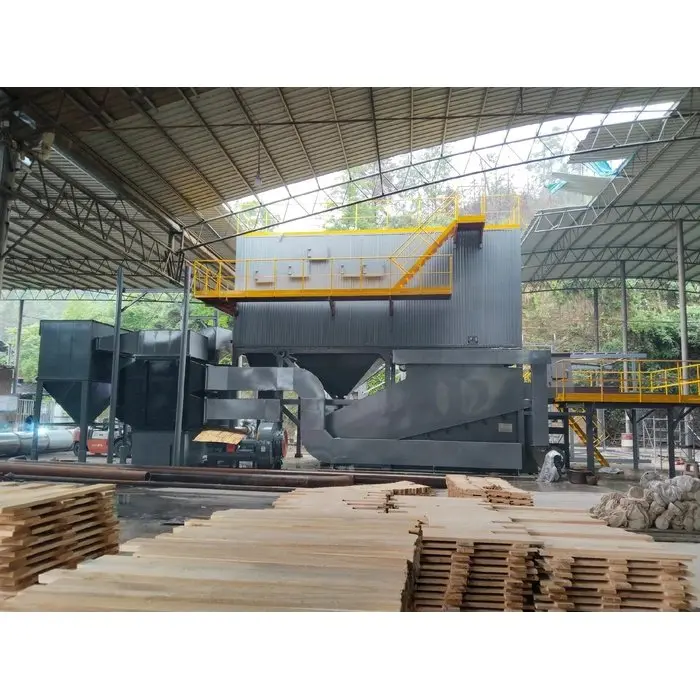
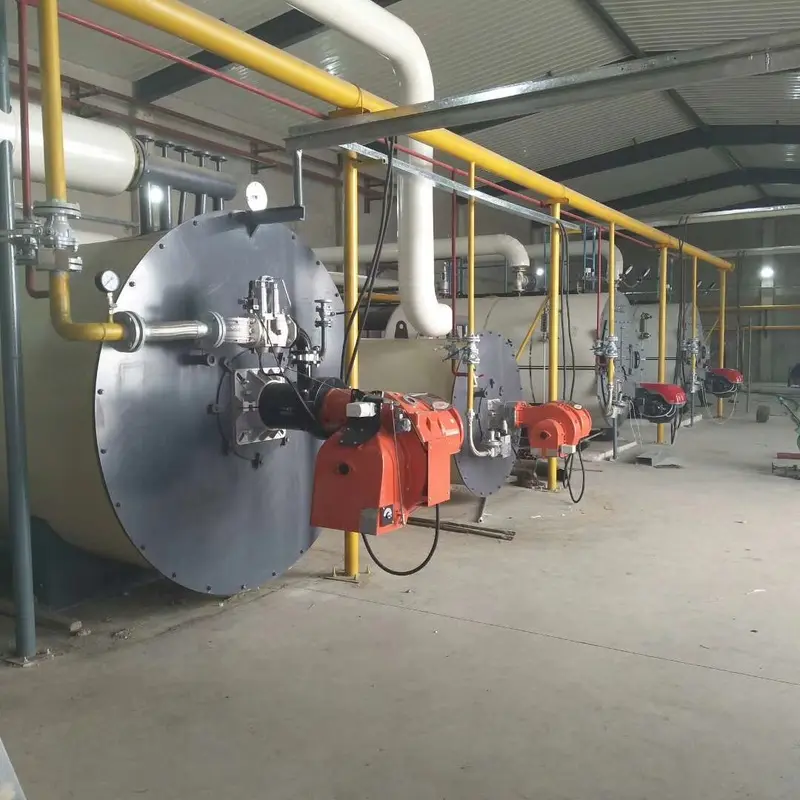
A gas burner with 5:1 turndown and full modulation costs more than a simple two-stage unit, and a dual-fuel burner more again. Biomass changes the machine, not just the burner: larger combustion volume, grate, fuel feeding, ash handling and dust collection all appear in the price.
3. Materials and coil design
Coil tube grade, wall thickness and heat-flux margin decide service life. A design that runs the tube hotter to save surface area is cheaper to build and more expensive to own — it cokes faster and shortens fluid life.
4. Pressure class, code and certification
| Requirement | Typical effect on package price |
|---|---|
| CE / PED documentation | +5–15% |
| ASME stamp (Section I / VIII) | +8–15% |
| National boiler inspection regime | +3–10% |
| Higher design pressure class | +3–8% |
5. Automation and electrical
A relay-based panel and a PLC with SCADA, remote monitoring and trend historian are different products. Explosion-proof (ATEX or equivalent) electrics on a unit installed in a hazardous zone add 10–20%.
6. Scope of supply
This is where quotations diverge most.
| Item | Typically included? | Effect if added |
|---|---|---|
| Heater body and coil | Yes | — |
| Burner and fuel train | Usually | +10–20% |
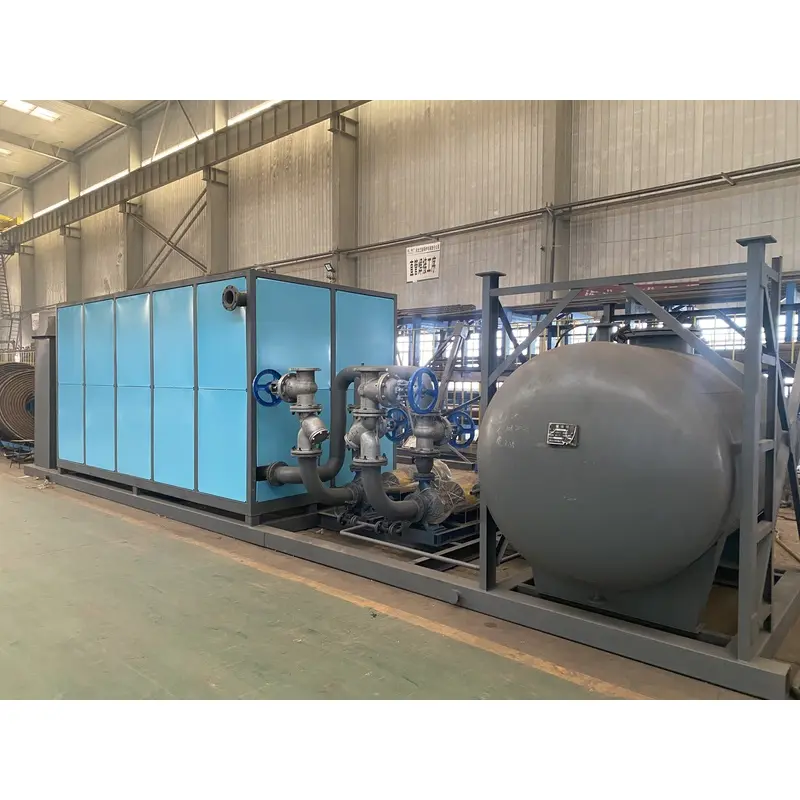
| Circulating pump | Often separate | +8–15% |
| Expansion tank and deaerator | Often separate | +5–10% |
| Economizer / air preheater | Optional | +5–10%, pays back in 1–2 years |
| Insulation and cladding | Varies | +5–10% |
| Control panel with PLC | Optional upgrade | +3–10% |
| Installation and commissioning | Rarely included | +10–25% of equipment value |
7. Logistics, installation and after-sales
Export packing, ocean freight, inland transport, lifting, alignment, refractory dry-out, commissioning, operator training, warranty length and a spare-parts package all sit outside the heater's build cost — and all appear on somebody's invoice eventually.
Roughly where the money goes
| Cost element | Share of the equipment package |
|---|---|
| Heater body, coil and refractory | 25–35% |
| Burner and fuel train | 10–20% |
| Circulating pump, valves and fittings | 8–15% |
| Expansion tank, deaerator, filter | 5–10% |
| Controls and electrical | 8–15% |
| Insulation, cladding and steel frame | 5–10% |
| Engineering, testing and documentation | 5–10% |
| Packing and freight | 3–8% |
Read a quotation against this table. If the burner is 8% of a package, the fuel train behind it is probably thin. If documentation is missing entirely, certification was not done.
The number that dwarfs the purchase price
For a continuously running industrial heater, fuel is not a cost item — it is the cost.
| Ten-year cost element | Share (4,000 kW gas-fired, ~6,000 h/year) |
|---|---|
| Fuel | ~88–92% |
| Capital cost | 5–7% |
| Maintenance and spares | 2–3% |
| Fluid replacement (2–3 changes) | 1–2% |
A worked comparison makes the point sharper. Delivered heat of 24 GWh per year (4,000 kW × 6,000 h) requires 26.7 GWh of fuel input at 90% efficiency and 26.1 GWh at 92%. The 0.58 GWh difference, at an industrial gas price of US$30–40 per MWh, is US$17,000–23,000 per year — every year, for a difference of two percentage points that may cost a few percent more at purchase.
This is why the useful question is never "which heater is cheaper" but "which system delivers a megawatt-hour at the lowest cost over ten years".
How to compare two quotations properly
Check that both answers match on all twelve points:
- Capacity quoted at your stated outlet temperature
- Fuel specification, burner make and turndown ratio
- Coil tube material, wall thickness and design heat flux
- Pump make, head, flow and seal type
- Expansion tank volume (should be 25–30% of loop volume)
- Instrument list — which transmitters, which switches, whose brand
- Control philosophy — relay, PLC, or PLC with SCADA and remote access
- Insulation specification and cladding material
- Certification scope and who pays for third-party inspection
- Spare-parts list and warranty duration
- Split between equipment, freight, installation and commissioning
- Delivery date and the penalty clause behind it
What to send for an accurate quote
Seven lines of information eliminate most of the back-and-forth:
- Required duty in kW or kcal/h, and the outlet temperature it is required at
- Inlet and outlet temperatures of the process side
- Fuel type and its calorific value, plus availability pressure for gas
- Fluid volume of the loop and the allowed cold-start time
- Installation environment: indoor/outdoor, ambient temperature, altitude, hazardous-zone classification
- Power supply: voltage, frequency, phases
- Certification and inspection requirements, and the destination port
Four ways buyers lose money
- Comparing price per kW across unequal scopes — it rewards the thinnest package.
- Undersizing auxiliaries — a small expansion tank or a marginal pump shows up as cavitation in the first month, not in the quotation.
- Skipping the economizer on a continuously running unit, where it typically pays for itself within two years.
- Leaving the fluid specification out of the contract — the cheapest available oil is often the one that cokes at 320°C.
Where to go next
- Gas and oil fired thermal oil heater — 100–28,000 kW, ≥92% efficiency
- Coal and biomass fired thermal oil heater — ≥86% efficiency, lowest running cost where agro-waste is cheap
- Electric thermal oil heater — ≥98% efficiency, no local emissions
- Chemical industry and asphalt industry solutions — typical system configurations for these duty profiles
Send us the seven inputs above and the quotation comes back itemised against this structure, so you can see exactly what each line buys.
Key takeaways
- No published price exists because capacity, fuel, materials, certification, scope, logistics and service are all variables — and they explain most of the spread between quotations.
- Capacity scales sub-linearly: doubling kW adds roughly 60–80%, while biomass adds 20–40% over gas.
- Fuel is 88–92% of ten-year cost. Two points of efficiency are worth US$17,000–23,000 a year on a 4,000 kW unit.
- Compare quotations on twelve scope points, not on price per kW.
- The cheapest-looking offer is usually the one with the shortest equipment list — check what is missing before checking what is priced.